25/10/2015

Elin Jones's radical proposals for the Welsh NHS

This post contains the main part of the speech made at the Plaid Cymru conference on Saturday by Elin Jones, Assembly Member for Ceredigion and Plaid's Shadow Health Minister. I'm publishing so much of it here because, apart from being typically waffle-free, it proposes the kind of radical changes  to the Welsh NHS that deserve a deeper read than that allowed by the usual online news articles:


"...My style is not to obsess over Labour’s failures. Not to dwell or rant about what’s wrong. My style is to offer solutions, to offer a vision of how a Plaid Cymru-run NHS would protect and improve services

"In the next Welsh Government Plaid Cymru will safeguard and strengthen our NHS with a 6 point plan.

"Our 6 point plan will:
     Cut waiting times for diagnosis and treatment
     Improve access to mental health
     Create a paperless NHS
     Tackle the public health threats of today
     Train a next generation of NHS workers
    Fully integrate health and social care & deliver equal care for equal need

Point 1
"We will cut waiting times for diagnosis and treatment.   Currently, 31.4% of Welsh patients are waiting over 6 weeks for a mri scan in Wales. In Scotland it’s 9.1%  and in England it’s  1.3%  Unacceptable.  Since 2011, there are 21000 more people waiting longer than 36 weeks for hospital treatment. 

·   "We’ll set up 3 Full Diagnostic Centres to provide a comprehensive range of tests and diagnosis, to enable cancer diagnosis to be confirmed within 28 days.

·   "We’ll set up dedicated Treatment Centres to undertake a very large proportion of elective, planned treatments and surgery. We’ve seen the success of the Golden  Jubilee Hospital in Scotland and how the SNP Government now intend to invest in more centres to further drive down waiting times and provide state-of-the-art effective surgical services. I want to replicate this is Wales.

·   "We would have one National Hospital Board to plan and deliver all acute and specialist hospital services. A Plaid Cymru Government next May would scrap all 8 Health Boards, and replace with 1 Hospital Board. 3 million people, fewer than 20 hospitals – we do not need 16 Chairs and Chief Execs for that job. 2 will be more than enough. We wouldn’t keep Betsi Cadwalader in Special Measures – we’d scrap it. National planning, but guaranteeing local delivery. And no community in Wales would be further than the magic hour from emergency, life-saving hospital services.

Point 2
"We would dramatically improve access to mental health services. 
Mental Health services deserve parity of esteem with Physical Health, and will not be an afterthought in a Plaid Cymru government.
  
"In the last 2 years, the number of children waiting longer than 4 months for their first appointment with a mental health professional has increased almost 5-fold. 50% of our most vulnerable children have to wait 4 months before they start treatment. That’s 4 months of disruption to their education, 4 months of anxiety and 4 months of waiting that can have lifelong effects. That is not acceptable.
So our priority would be to ensure no child waits longer than 4 months for mental health treatment. Our children and young people can not be allowed to be the victims of a poorly-run Labour Government.

Point 3
"We would create a modern, paperless NHS – fit for the 21st century. It cannot be right that you can go into a District General Hospital and see porters still wheeling large trolleys of patient files and notes. It can’t be right that I can book a hotel room in Buenos Aires on my smart phone from this stage right now, but I can’t use my smartphone to book an appointment or repeat prescription from my surgery just down the road.
·      We need universal electronic patient records that are accessible to every part of the NHS, wherever the patient presents at any point in time.
·      We need Skype clinics to reduce the number of patient visits and miles.

"But a modern 21st century NHS is not just about more imaginative use of IT. It is also about cutting-edge research and treatments.  I want to see more university-led medical research in Wales, also more pharmaceutical and private sector research in Wales. Our senior medics and researchers need to lead more clinical trials – for the benefit of Welsh patients. And we will bring to an end the postcode lottery of access to new treatments and drugs.  We want a NHS that is be fair and transparent in decisions that affect whether a person lives or dies.

Point 4
"Plaid Cymru will tackle the big public health challenges that face our nation.  Whilst the current Welsh Health Minister fixates on banning e-cigarettes in public places, Plaid Cymru will address the major causes of harm.  We will use new taxation powers to introduce a sugary-drinks tax. When Plaid Cymru first announced this policy 2 years ago in Aberystwyth, we were ridiculed by Carwyn Jones and Welsh Labour. David Cameron is equally set against a sugary drinks tax.

"But public health experts and medical organisations all now support a pop tax. And Jamie Oliver endorsed our policy and Plaid Cymru backs his campaign. But, a Plaid Cymru government will not introduce a poptax in Wales just because it’s backed by a certain celebrity chef. We’ll do it because the harm that is done to our children’s health by over-consumption of unnecessary sugar cannot go unchallenged.

Point 5
"Our NHS is the sum of its parts. And its parts are its staff. Without a motivated and well-rewarded staff, then the NHS crumbles. We all owe a huge debt of gratitude to all the staff working in our NHS and wider health and social services. They do sterling work day in, day out. And yes, Jeremy Hunt, they already work weekends and nights.  A Plaid Cymru Government would not seek to undermine the work of NHS staff in the same way as Jeremy Hunt is England – targetting the junior doctors today, and someone else tomorrow.

"We would protect today’s staff and plan for tomorrow’s staff.  It is scandal that the Welsh Labour Health Minister is shying away from any action to properly plan for the workforce. Plaid Cymru would create a National NHS Workforce Plan.  We’d start by prioritising doctors – and we’d train and recruit an additional 1000 doctors over 10 years.

 "To do so we would create financial incentives to attract doctors to hard-to-recruit areas and specialisms, but we’d also ensure more capacity in medical schools – in Cardiff, Swansea and Bangor. They would be medical and nursing schools to serve and supply the Welsh NHS and we would place a percentage quota of student places for Welsh students in our medical schools.

"Our workforce plan will start with doctors, but it will become a plan for all health and social care professionals.

Point 6
"And finally, our most ambitious plan of all. Where others talk about fully integrating our health and social care systems – we will do it.

"Two systems set up by great pieces of 1940s legislation. Two systems – health and social care – separated at birth. Health care free at the point of need and social care means-tested and assessed at the point of need.  Health care provided by the NHS, social care by Local Authorities.    
        
"They were systems of their time, but they are no longer in synch with the needs of today.

"Before I became Shadow Health Minister, I was the Minister for Rural Affairs, dealing with animal health matters, rather than human health. Looking back, I think I can say that there is better integration of health and social care in agriculture, than in human health and social care!  Farmers do the social care bit, and vets do the health care – and they do it in an integrated, effective way – even in times of crisis.

"Plaid Cymru will create a Community NHS – to combine GP surgeries, community nursing teams, other community health professionals and community hospitals, out-of-hours GP services and community mental health services and adult social care. 

"Local authorities would be given the lead responsibility of managing and delivering Community NHS. Services would be planned coherently and delivered seamlessly.

"However, will organisational change on its own deliver the seamless care that our elderly and vulnerable need? In the current system, the diagnosis you have in large measure determines the financial support you get to cope with its effects.

"In the 21st century, it is simply not acceptable that people with conditions that can involve very similar burdens, such as cancer and advanced dementia, can end up making very different contributions to the cost of their care.

"In Government, Plaid Cymru will end the historical divide and current inequalities between health and social care, we will ensure “equal support for equal need”

"The final barrier between full health and social care integration is the answer to the question who pays? For health care, it is the state, and for social care, it depends. For a cardiac patient it is the state, for a dementia patient, it depends. It depends on the assessment of need and on a means-assessment.

"Plaid Cymru is committing to provide free social care for all over 65s within 10 years, with clear milestones along the way.

1  "Firstly, we will introduce free personal care for the elderly within the first 2 years of Government. This would abolish all fees for non-residential care.

  "Secondly, we would abolish charges for those with a dementia diagnosis within 5years – including for nursing and residential care.

    "Thirdly, we would completely abolish all social care charges for the elderly within a second term of Welsh Government

"This a fully-costed plan and it will provide equal care for equal need. That is our pledge – equal care for equal need, so that in 21st century Wales - those people that care and those that are cared for will be guaranteed quality care and dignity of care, without financial fear or financial burden.

"For May next year, Plaid Cymru has the policies and priorities to strengthen our NHS. Labour’s poor, poor record on health can not be allowed to continue.  Labour Ministers have been unwilling to take the big decisions on the NHS and unable to get the small decisions right. 

"They have spent too much time over the past 4 and a half years blaming a Westminster Government for a lack of funds.  There should be no more excuses.  Labour should be judged on what it has failed to achieve with the powers and budget available to it, and we will be judged on what we promise to achieve within the powers and budget available to us.

"The people of Wales deserve better than to hear Labour politicians blame others for what can and can’t be achieved.  There is a change that our NHS needs. There is a change that Wales needs. Plaid Cymru is that change."

01/08/2015

Ceredigion agrees grant funding to reduce HMOs

With the continuing uncertainty about the housing market in Aberystwyth, exacerbated by the new additional student accommodation at Fferm Penglais on Clarach Road, Ceredigion Council has agreed a number of measures to improve the town's housing stock and encourage a reduction in the number of  Houses of Multiple Occupancy (HMOs) in the town:

* An energy efficiency grant of £5,000, focussing particularly on the many deficient and drafty sash bay windows in HMOs around the town plus wall and loft insulation.

* A grant of £5,000 for converting HMOs of four or fewer bedrooms back into traditional single households.

* A grant of £10,000 to convert an HMO into self-contained units, i.e. flats that would reduce the density of the property.

The new measures, detailed on page 3 of this link, will be the subject of discussion at the next Landlord’s Forum on 24th August, the latest of the regular discussion meetings held between the Council and local landlords.

The money is being made available by the Welsh Government as part of the Housing Renewal Area scheme. Property owners are expected to match the grant money.

Although HMOs undoubtedly serve a purpose, the numbers in some streets, with the resultant pressure on parking spaces and other issues, have led to concerns for many years. Ceredigion is taking the opportunity provided by the current changes in the local housing market to address these issues.

09/07/2015

Feasibility study for Bow Street station and transport hub

This is an English language version of an article published earlier in the excellent Welsh language news site Pobl Aberystwyth

There was dismay last month when it was announced that Ceredigion Council’s bid to the Welsh Government for £409,000 worth of funding for initial work into a new Bow Street station and transport hub, just north of Aberystwyth, had been turned down. I’d been chairing meetings of a group of Ceredigion councillors and others to make the case and had been hopeful of a better result. 

However, following further work behind the scenes, questions by Ceredigion AM Elin Jones in yesterday’s Assembly plenary session in Cardiff Bay brought the following response from Edwina Hart, the Welsh Government’s Minister for Economy, Science & Transport: 
“I have asked my officers now to initiate work on a feasibility study about Bow Street”. 

Those brief words mark a huge step forward in the campaign and supporters of the idea will now be keenly seeking more information about timescales. 

The idea behind a new Bow Street station is that, apart from serving the 2000 residents of the immediate village - and 1000 more in nearby Penrhyncoch - the site could become a transport hub to the whole area to the north of Aberystwyth.  

The intended setting is on the site of the old station, closed in June 1965, next to the intersection of A roads at the South end of the village. The University have firm plans to further develop their Gogerddan campus, just over half a mile away. Any promise of a new station, incorporating a pedestrian and cycle link to their site, would give those plans a big boost. 

By incorporating a Park & Ride car park alongside the station, such a hub could provide an option for those driving to Aberystwyth from the North to travel the last three miles by train or bus, avoiding the frequent early morning traffic queues on Penglais Hill and the stress of finding a parking spot in town. The obvious benefits to the town would make it worthwhile for the County Council to promote the kind of shuttle services that would make this option attractive.

With the commencement in May of a peak-time hourly service on the Cambrian Line and the recent announcement by the Minister of funding for an ‘options appraisal’ on a potential new Aberystwyth-Carmarthen rail line, the latest statement on Bow Street adds to the optimism being felt at the moment by all of us campaigning for improved rail services in Mid Wales.

07/06/2015

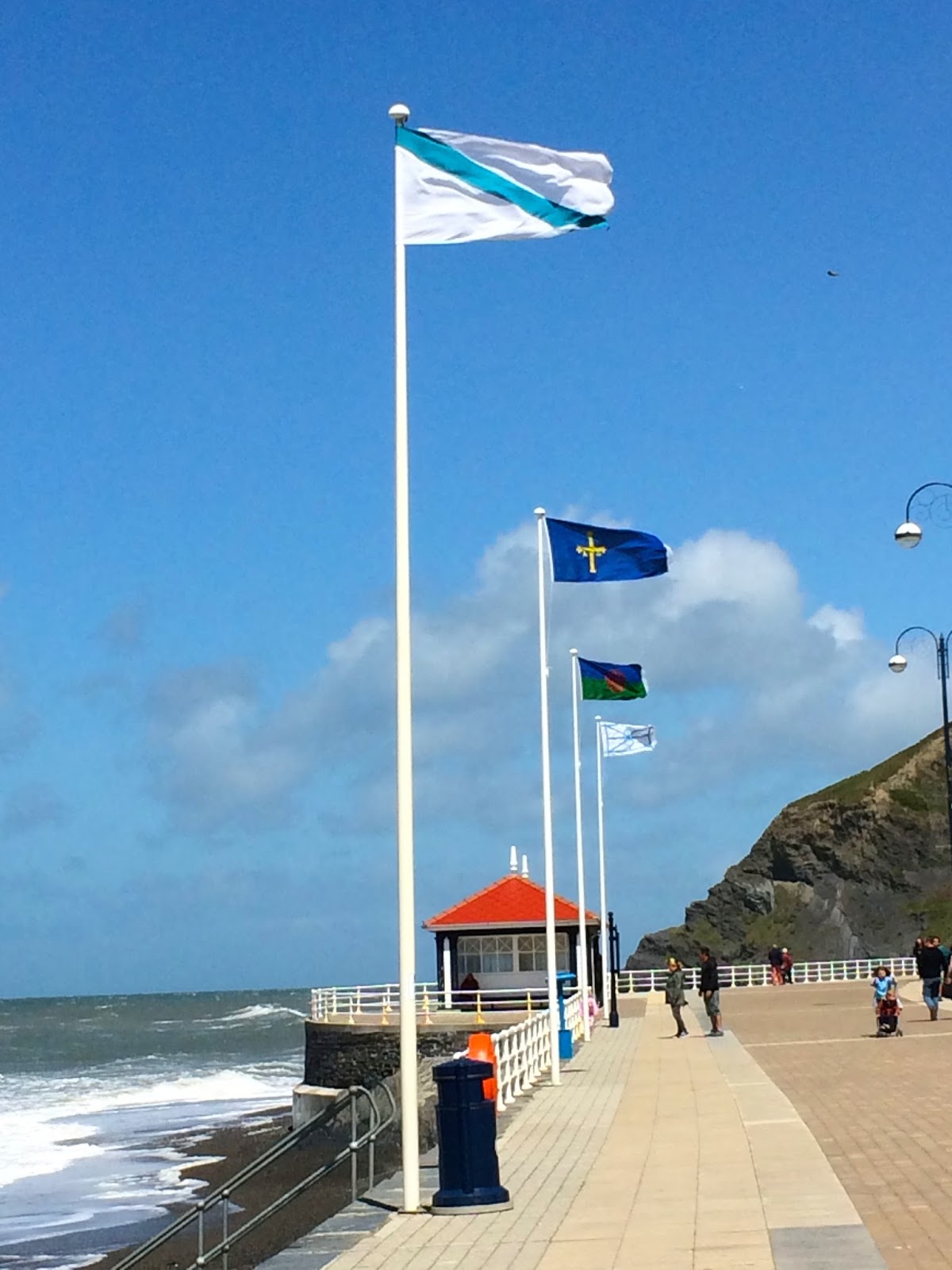
Renewal of Aberystwyth's small nation flags


It’s very common to see the flags of various long-established nations fluttering in the breeze on the promenades of seaside towns, like those on Aberystwyth’s South Prom. However, since 1990, the town's North Prom has also displayed the flags of twenty European stateless nations and peoples. 

At the time, the original supporting booklet for the project explained,
“When a Welsh person visits another country it is often the case that a display of flags is encountered adorning some public building or space. More often than not the Red Dragon of Wales is not found amongst them. Realising that inhabitants of minority nations throughout Europe probably experience similar disappointments, the District Council of Ceredigion has resolved that as many as possible of the flags of Europe’s minority nations should be flown at Aberystwyth every summer.”

Since then, three of the places originally represented - Estonia, Latvia and Lithuania - have become fully fledged nation states and there have been many other changes around Europe, so it felt like about time to have a revamp.

Ceredigion Council therefore consulted the organisation behind the original project - The Mercator Institute for Media, Languages and Culture based at Aberystwyth University - and they recommended a renewed list of flags which are now up and flying in all their glory.

With twenty places available, not all the possibilities could be included. The flags chosen for display this year are, in alphabetical order: 
The Aromanians, Asturias, The Basque Country, 
Britanny, Catalonia, Cornwall, Corsica, Flanders, Frieseland, Friuli, 
Galicia, Isle of Man, Kashubia, Occitania, 
The Romani, Saami, Sardinia, Scotland, Sorbia, Wales.

The small nation flag display on Aberystwyth’s North Prom is, as far as I’m aware, absolutely unique. It educates and points to an alternative, bottom-up view of nations and cultures that feels like a distinctively ‘Aberystwyth’ way of looking at the world.

17/05/2015

And then there were 3,067

In the last few days of the election period, those of us campaigning for Plaid Cymru’s Mike Parker on the doorsteps of Ceredigion could tell there was a significant shift taking place towards Plaid but couldn’t tell by how much and were privately doubtful if the movement would be enough. That proved to be correct, with the Lib Dems finishing the night with their previously majority cut by 63%, or 5,257 votes, with a reported 6.8% swing to Plaid Cymru. The new Lib Dem majority is 3,067, making the constituency a marginal seat according to the accepted definition.

If Mark Williams was not such a personable local constituency MP with such a large majority heading into this election, he would almost certainly have joined the 49 other Lib Dems who lost their seats on that Friday morning. His undoubted good work with people on a personal level seems to have innoculated him against too much public disapproval at the way he has regularly voted in Parliament in support of the government’s austerity agenda. 

He has certainly succeeded in managing to keep his voting with the Tories very quiet during the past five years. When challenged on his voting record by clued-up opposition activists in many of the 15 hustings held around the county during the campaign, he argued that he had been forced to vote in the ways that he had by his party whips and recounted how very, very difficult encounters with these apparent rottweilers could be. This was a difficult argument to pull off since, simultaneously, he seemed to be trying to present himself as more of an Independent MP than anything as embarrassing as a member of the Lib Dems, mention of whom was notably downplayed in election literature. 

There's a theory that Mark's success actually represents a kind of  ‘anti-politics’ - a vote for an individual who does well at giving a particular service without being seen to get too involved in that messy, contentious politics stuff with its difficult dilemmas about how the country should be run. 

It can be a salutary lesson for activists steeped in policies when they present what seems like a cast iron, logical case for change on the doorstep only to be faced with an elector who, although perfectly intelligent, is unfamiliar with the word austerity and simply wants to vote for someone who seems nice in a coffee morning. 

I do think we underestimate the importance of this personal side in politics at times. But if what an MP votes for in parliament really doesn’t matter anymore then our democracy has problems. And to have Ceredigion’s representative voting with the Tories to dismantle the welfare state is unacceptable.

For Plaid's Mike Parker, the campaign began with the kind of bad-as-it-can-get headline in the local press, about something he wrote 14 years ago, that would have poleaxed most candidates. In footballing terms it felt a bit like one of those matches when a team has a player sent off in the first few minutes and spends the rest of the game trying to hold on against the odds. Although for some electors the headline never went away, Mike’s resilience meant that, over time, it began to matter less and less.

Another notable aspect of the election in Ceredigion was the improvement in the standing of the parties outside the top two. UKIP (+7.7%), Labour (+3.9%), and the Greens (+3.8%) will all feel reasonably pleased with their results, although the Tories, with what most people regard as a suspiciously lacklustre campaign, stood still. The Greens saved their deposit for the first time in the constituency and their Ceredigion result was their second best in Wales next to Cardiff Central. Given Ceredigion’s Plaid/Green history and Mike Parker’s own strong green credentials, their decision to contest the seat disappointed many but was probably inevitable.

One of the features of the last two Ceredigion elections has been the evaporation of the votes of the parties outside the leading two in the constituency, with an ‘anti-Plaid’ vote seeming to coalesce around the Lib Dems' 50% in 2010. This time, with the Lib Dem vote reduced to 35.9%, the combined Labour, Tory, Green and UKIP candidates are back to the kind of levels being won by the lower scoring parties when Plaid controlled the seat between 1992 and 2005. That trend would seem to give Plaid reason to hope that they can come through the middle to win again in the future.

It's often deceptive to pay too much attention to the feeling within a campaign team. But it must be said that this was undoubtedly the most enjoyable and well-run Plaid campaign for many years. Those turning out to knock on doors were of all ages and sometimes reached unmanageable numbers, having to be split into sub-teams. This was was probably due to a combination of the freshness provided by Mike Parker's candidature, Leanne Wood's groundbreaking performances in the TV debates and a sense that, in what the polls were telling us was a dramatically changing wider political picture, a win might just be possible. No other party in Ceredigion can come close to matching Plaid’s ‘troops on the ground’. The entire Lib Dem parliamentary party now numbers no more than a Plaid canvassing team on an average night in April.

A rally at Aberystwyth University with Leanne Wood on the Monday before polling day (below), followed by a street walkabout with Catrin Finch, was a huge success. Again, no other party in the constituency could dream of pulling that sort of event together. But, in the context of a Westminster election, that campaigning ability doesn’t necessarily translate into decisively more converted votes.

So, for Plaid Cymru in Ceredigion, it’s a case of having plenty of regrets that we couldn’t come closer to winning but just as many positives to take from the campaign. There’s a strong sense that, with Leanne Wood’s leadership, Plaid is on the up, both here and across Wales, and a lot of optimism about next year’s Assembly elections where, in a changing political landscape, a good campaign will see an increased majority for Assembly Member Elin Jones and Plaid Cymru returned to government in Cardiff.

Thanks to the excellent Griffblog for the image

05/05/2015

Cheers and ovations at Plaid's election rally in Aberystwyth


Here's the finale to the event below - Elin Jones, Leanne Wood and Mike Parker receiving a standing ovation from the crowd of over 250 in the Hugh Owen Building at Aberystwyth University on Monday.

02/05/2015

Leanne Wood giving keynote speech in Aberystwyth on Monday


Plaid Cymru Leader Leanne Wood will be delivering a keynote speech in Aberystwyth on Monday 4th May at 12:30pm in the A12 lecture theatre in the Hugh Owen Building on the Penglais Campus. 

This will the first chance many people in Ceredigion will have had to meet Leanne following the groundbreaking part she played in the series of televised election leadership debates.

The 300-seat A12 theatre is opposite the Penbryn building and TaMed Da restaurant, just inside the main university entrance. Everyone is welcome.

Leanne is pictured here with Mike Parker, Plaid Cymru's election candidate for Ceredigion, who will also be  at the event.

17/04/2015

Ceredigion's solar power commitment

Over 200 solar panels have been erected on Ceredigion Council offices in Aberaeron in the last month - saving tons of carbon each year and also saving money on fuel in the long term.

The photos show Penmorfa and Min y Mor offices.


06/04/2015

Ceredigion's MP - representing Ceredigion or Westminster?


What practical difference would a Plaid Cymru MP like Mike Parker make in Ceredigion? Firstly there's the massive anti-austerity message that a Plaid Cymru win would send out, together with the increasing likelihood of having a key influence in a hung parliament alongside the SNP. But for anyone interested in policies and values, one of the best way to judge is to look at how our current Lib Dem MP has been voting at Westminster. 

Below are listed some of the ways he’s been voting, as recorded on the website ‘They Work for You', where a Plaid Cymru MP would differ markedly.  I must admit I’m quite shocked at some of the voting patterns.

Because some votes are complex or multi-layered, the website uses a scoring mechanism to judge on whether the MP has voted 'moderately', 'strongly' or 'very strongly' on each particular issue. These are all quotes from the website. My comments are in brackets.

Welfare and Benefits 
Voted moderately for a reduction in spending on welfare benefits
(Disappointing)

Voted moderately for reducing housing benefit for social tenants deemed to have excess bedrooms 
(i.e. the ‘Bedroom Tax’ - very disappointing to see this)

Voted strongly against spending public money to create guaranteed jobs for young people who have spent a long time unemployed
(I'm really surprised by this)

Social Issues
Voted moderately for laws to promote equality and human rights
(Only moderately?)

Taxation and Employment
Voted moderately against a banker’s bonus tax
(Astonishing)

Health 
Voted strongly against restricting the provision of services to private patients by the NHS.
(Thereby accepting the increasing privatisation of the health service - Plaid Cymru are committed to opposing this)

Education
Voted very strongly for ending financial support for some 16-19 year olds in training and further education
(Very surprising)

Constitutional Reform
Voted strongly for reducing central government funding of local government
(And then blames local councils for cuts to services?)

Voted moderately against a more proportional system for electing MPs.
(i.e. failed to back Caroline Lucas’s enlightened motion to broaden the debate on proportional representation, even though PR is supposed to be a key Lib Dem policy. The loss of this motion was then followed by the disastrous AV referendum in 2011 in which the Lib Dem’s choice was heavily defeated).

Voted moderately for greater restrictions on campaigning by third parties, such as charities, during elections.
(Generally seen as a measure aimed at restricting debate - surprising)

Voted a mixture of for and against transferring more powers to the Welsh Assembly.

Voted moderately against transferring more powers to the Scottish Parliament.

Voted moderately against more powers for local councils.
(Looking at the last three together, there’s not much commitment to decentralisation going on there...)

Home Affairs
Voted strongly for the introduction of elected Police and Crime Commissioners
(Has proved to be hugely unpopular - Plaid will vote to abolish)

Voted moderately for requiring the mass retention of information about communications
(Basic Lib Dem tenets seem to be going out of the window here)

Miscellaneous Topics
Voted moderately against greater regulation of gambling
(Surprising)

Voted moderately for financial incentives for low-carbon emission electricity generation methods.
(Only moderately?)

Voted moderately for measures to prevent climate change 
(Only moderately?!)

Voted strongly against slowing the rise in rail fares 
(Absolutely amazing)

Has never voted on selling England’s state owned forests
(Shame)

Voted moderately for restricting the scope of Legal Aid
(Disappointing)

Voted a mixture of for and against the privatisation of Royal Mail
(Incredible)

Voted moderately for the policies included in the 2010 Conservative-Lib Dem Agreement.
(And there lies the nub of the problem)


Put together, this list is pretty damning, and it certainly doesn't represent the wishes of the people of Ceredigion.  

I don’t know which votes were whipped or how strongly (’The Tories/Nick Clegg made me do it’?) but, with the Lib Dems refusing to rule out another coalition with the Conservatives, and Plaid Cymru's Leader Leanne Wood explicitly ruling out any co-operation with them at all,  it’s clear where people of any kind of green or left persuasion should not be placing their vote on May 7th.

On the other hand, Plaid Cymru's manifesto is here. If you're interested enough in policies to get to the end of this article, it's worth checking out.

14/03/2015

James Bond - an invitation from Ceredigion


This week's argument over the Welsh Government’s po-faced banning of the filming of the next James Bond film in the Senedd in Cardiff Bay brings to mind a similar debate in Ceredigion Council.

When the first series of Hinterland/Y Gwyll was being planned in 2012, the programme's producers asked if they could use Aberystwyth’s ‘Swyddfa’r Sir’, still known by many as the old Queens Hotel,  a prominent large building then owned by the Council next to the Promenade. The department responsible gave the then default answer of ‘No’, presumably stemming from a similar mindset to that of the Welsh Government officials. 

However this was just after the local government elections and Plaid Cymru’s Ellen ap Gwynn had become Council Leader only a week or two before. A long-time champion of the arts, on hearing about the refusal she quickly called a meeting and had the decision reversed. 

The result is that the building has now been seen around the world as the police station base for DCI Tom Mathias and his colleagues as they puzzle over the murderous secrets lurking in the brooding landscapes of North Ceredigion.

This provides the kind of advertising for the area and economic boost that no amount of money can buy, not to mention the big feel-good factor of having the cast and crew becoming a part of the town. In Ceredigion’s case this boost came about because of political leadership. With Plaid Cymru still leading the Council, I'm sure Ceredigion would be happy to come to a similar arrangement with James Bond...

10/03/2015

Ceredigion commits to sustainable timber pledge


Last week I attended a World Wildlife Fund (WWF) reception in the House of Commons. Ceredigion Council was invited because we're one of only three local authorities in Wales that have committed to the WWF Silver Pledge on timber procurement. The Pledge means that the Council agrees to help support the market in legally and sustainably sourced timber by only purchasing carefully selected products.

The reason some forms of non-sustainable wood (i.e. wood from sources that are running out and not being replaced) is used for many projects elsewhere is its ability to resists decay and attack from organisms, along with its all round strength compared to most other woods. This is especially relevant for the kinds of marine projects that Ceredigion, as a coastal authority, is involved in. 

However, with much of this wood coming from Guyana in the Northern Amazon area, the problem with this is obvious - it means the continued depletion of the Amazon rainforest that is vital for the carbon management of the planet.

Ceredigion therefore now sources its wood, including that used for coastal projects, from sources that are certified as sustainable by the WWF.

In the case of the most recent coastal defence work at Borth (below), the Council has gone a step further and recycled the old groynes that were removed at the start of the project.

05/02/2015

The Aberystwyth to Carmarthen railway - two new supporters

For all of us campaigning for a new rail line between Aberystwyth and Carmarthen, there was a very encouraging interview with the Transport Minister Edwina Hart on The Wales Report last night. Here's some of what she said to BBC news presenter Huw Edwards:

Edwina Hart: "I have to say that rail in Wales is very important. We're not linked properly as a nation in Wales and I think this is a big issue for me. I would like, in an ideal world, to be able to get on the train in Swansea, go all the way round West Wales and come back down the East side."

Huw Edwards: "We'll all say Amen to that".

Edwina Hart: "But I think it's important to recognise you can take some steps on this. But, also, to take steps on this we have to be able to control the existing franchise. We need to look at what powers we need in the future. We need powers over Network Rail, because Network Rail decide what new lines come in.

"Well I've already been having discussions about the possibility of Carmarthen - Aberystwyth line reinstatement. And people say 'pie in the sky'. But I say 'no' - if you look at the way that other European countries look at the way they run rail, why shouldn't we be ambitious?

"So there's a lot of issues on the agenda. Not just the franchise - further devolution of powers. We need to have the powers the Scots are likely to get. And I think it's very important to recognise that it's about nation-building as well, in terms of the rail, not just about having a railway line and taking people back and fore to work. That is important - it's important for tourism - but it's also important that, as a nation, we have a proper rail network."

So now we have two more supporters of the campaign - the Transport Minister....and Huw Edwards.

01/02/2015

Wind turbines for Aberystwyth University


These circles mark the sites where Aberystwyth University is planning to erect wind turbines - one just beyond Fferm Penglais, the new student village, and two at Gogerddan. The three 30 metre, 250Kw turbines could apparently provide 10% of the Uni's electricity needs.

As the consultation information says,
"The project, which would cost about £2.5 million, would also help protect the University from future increases in energy costs, help to ensure security of supply, assist in meeting targets to reduce carbon emissions and provide a reaching resource for students to access as part of their studies".

Details about the consultation events taking place in the next three weeks, and the next steps in the project, can be seen here and here

20/01/2015

Ceredigion best in Wales at narrowing pay gap

Ceredigion Council can be fairly proud of the progress made in narrowing the pay gap between its lowest and highest paid workers. 

Since the last local government elections in 2012 the Council has removed its three lowest pay bands, with a fourth due to follow in May. At the same time, a deliberate restructuring has ensured that the wage bill for senior officers has fallen considerably.

The latest figures show that Ceredigion Council now has the smallest difference in the whole of Wales (and undoubtedly beyond) between its lowest paid staff and that of the Chief Executive. Ceredigion’s ratio is 1:8.4, whereas some neighbouring authorities are at 1:12 or even higher. 

Looking at the table below, one party clearly emerges as taking the issue of reducing the pay gap the most seriously. This is no accident. The present Ceredigion leadership is mindful of the Spirit Level campaign which has shown that more equal societies have far better economic, health and general well-being outcomes. 

The intention is to make further progress towards the Living Wage, although this is not easy at a time of unprecedented austerity from the Westminster government. The continuing austerity agenda was supported by all the main parties in the recent House of Commons vote and, to compound this, the Welsh Government has subjected Ceredigion to the largest percentage cut of any of the Welsh Councils.

Despite this, Ceredigion is evidently helping to provide a small local counter-balance to the prevailing economic trend of growing social inequality.